What Is TFT LCD
Leave a message
What Is TFT LCD
What Is TFT LCD Mean?
TFT LCD is short for A thin-film transistor liquid crystal display, which is built by layering thin films on a glass substrate, hence the name. This technique is commonly used for creating microprocessors. The TFT in the LCD controls individual pixels in the display by setting the level of the electric field across the three liquid crystal capacitors (one for each sub-pixel of red, green and blue) in the pixel in order to control the polarization of the crystal material. The amount of polarization in the crystal determines the amount of light that reaches the color filter from the backlight. Because of this ability to directly and quickly control each pixel, TFT is also called active-matrix LCD technology.
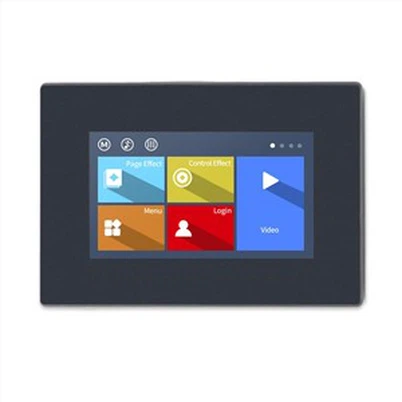
A TFT LCD monitor is a type of flat-panel display that works as either a computer monitor or as a display for a TV. TFT LCD is short for thin film transistor liquid crystal display. Most of the time, manufacturers shorten the term for such displays to LCD, dropping the TFT from the name since this abbreviation simply refers to the type of LCD monitor, and TFT is easily the most popular type.
The thin film transistor consists of a thin piece of a semiconductor material applied over a glass substrate. Each pixel has its own transistor along with the liquid crystal material. The liquid crystal material exhibits properties of both a liquid, because of its ability to change quickly, and a crystal, because of its ability to remain in an arranged position. The transistor applies a voltage to the pixel, determining its color and intensity. A pixel is short for picture element, and the tiny pixels blend together to create the image on a display.
Another name for a TFT LCD monitor is an active-matrix LCD. Although TFT is not the only active-matrix technology, it is overwhelmingly the most common type, causing some people use the two terms interchangeably. A TFT is only a small part of an active-matrix LCD, however. The term active-matrix refers to the ability of the monitor to control individual pixels and switch them quickly.
Active-matrix LCDs differ from passive-matrix LCDs in several ways. They have a high refresh rate, high contrast, and high response times, at least when compared to passive-matrix displays. A passive-matrix LCD is commonly found in a calculator display or a digital wristwatch, where the display contains a limited number of segments and does not require full color. Active-matrix displays usually are high-resolution, full-color LCDs, and they include those found in computer displays, cell phones, and TVs.
A few different types of thin film transistor technology may be are found in a TFT LCD monitor. The most common for computer displays and TVs is called a twisted nematic (TN) display, which features quick response times. TN displays do not excel in the areas of screen viewing angle and color reproduction, however. Another common monitor technology is IPS, short for in-plane switching. An IPS display offers great color and good viewing angles, but its refresh rates are slow.
LCD liquid crystal
Liquid crystals are almost transparent substances and exhibit the characteristics of crystals and liquids at the same time. Two glass plates sealed with epoxy resin and with a groove in the left corner allow the introduction of liquid crystals (under vacuum) before the final sealing of the glass plates. The potential difference determines the orientation of the liquid crystal. When polarizers and color filters are used, the difference in the orientation of the liquid crystal causes the difference in transmittance (or reflectance) and the resulting color. Liquid crystals are substances that present different phases (solid, liquid crystal or liquid) at different temperatures
Leveling film
The film is deposited on two glass plates (upper and lower), with a series of parallel grooves, so that the liquid crystal molecules are aligned in the appropriate direction (Figure 5 has a series of parallel grooves, so that the liquid crystal molecules are aligned in the corresponding direction)
LCD development
Liquid crystal was discovered more than 100 years ago. When heated, their external state can change from solid to liquid crystal, and even completely transform into liquid form as the temperature rises further. Over the years, people have made great efforts to improve liquid crystals, and as a result they have been widely used in electronic calculators and digital clocks. At present, the application range of color liquid crystal is wider: mobile phones, personal computers and TVs, which have the characteristics of low thickness, low power consumption, high resolution and brightness. In addition, in the foreseeable future, driven by the rapid spread of flat panel displays, the demand for LCD panels is expected to grow substantially.
How does LCD work
When a voltage is applied to the two LCD electrodes, the stronger the "unfolding" of the liquid crystal molecules, the higher the applied potential (Figure 6). Voltage sensitivity is one of the main characteristics of liquid crystals. Figure 7 shows the normal "white" mode of the LCD. As long as no potential difference is applied, light can pass through the liquid crystal layer, and the liquid crystal molecules will change the orientation of the light plane according to their own angle. However, when a voltage is applied, the liquid crystal molecules will "unfold" and "straighten" the light directed to the upper polarizing filter. Therefore, light will not be able to pass through the active area of the LCD, and this area will be darker than the surrounding area.
LCD control mode
Figure 8 shows the LCD control circuit. In a selected period of time, the switch is closed and an input voltage is applied to the liquid crystal, which will cause the orientation of the liquid crystal molecules to change. When the switch is closed, a certain charge is stored in Clc, and the voltage across Clc decreases with time. Consider adding a storage capacitor Cst in parallel with Clc to expand the storage capacity of the charge.
Energy storage capacitor
In fact, the control of the liquid crystal must be carried out by AC voltage. To activate the LCD, voltage is applied only when the switch is turned on, and then the switch is turned off immediately. In some cases, the voltage across the liquid crystal drops due to leakage. To prevent this, we can use a parallel capacitor to compensate for the leakage voltage. As the capacitance Cst increases, the shape of the voltage across it is close to a zigzag
The working principle of TFT LCD
The TFT acts as a switch. The gate of the TFT is connected to the scan line, the source is connected to the data line, and the drain is connected to Clc and Cst. When the shutter is activated (selected on the scan line), the TFT channel is opened, and the image data will be written into Clc and Cst. When the shutter is not selected, the TFT channel is closed
The basic structure of TFT LCD
The core of TFT-LCD structure includes liquid crystal, two polarizers and glass plate: upper color film substrate and lower TFT array substrate. Inject liquid crystal material between the two glass plates
Luminous flux adjustment
By controlling the magnitude of the input voltage applied to the liquid crystal, the arrangement, orientation and direction of the molecules can be changed, which will cause the volume of the luminous flux through the liquid crystal to change accordingly