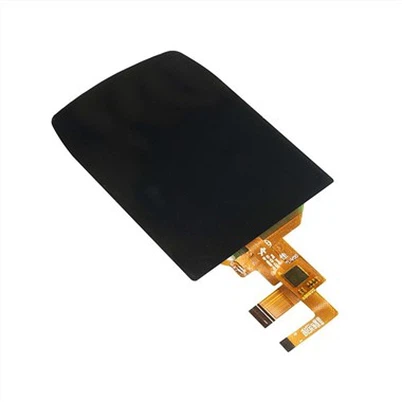
Summary of common knowledge points of liquid crystal display
Leave a message
What is a liquid crystal display LCD?
The main principle of LCD (Liquid Crystal Display, abbreviated as liquid crystal display in Chinese) is to generate dots, lines, and surfaces by stimulating liquid crystal molecules with electric current to form a picture with the back light tube. At present, common liquid crystal display devices are TN, STN, DSTN and TFT. The first three have the same manufacturing principles and become passive matrix liquid crystals, while TFT is more complicated. Because of its memory, it is called active matrix liquid crystal. The display has the advantages of small space, thin panel thickness, light weight, flat right-angle display, low power consumption, no electromagnetic wave radiation, no heat radiation, etc., making it gradually replace the traditional CRT video tube monitor.
Structurally, the LCD panel is mainly composed of four major components:
Major LCD panel manufacturers?
South Korea: Samsung, LG, etc.
Japan: Sharp, JDI, NEC, etc.
Taiwan: AUO, Innolux, HannStar and Huaying, etc.
China: BOE, Tianma, CLP Panda and Longteng Optoelectronics, etc.
Here are some basic knowledge questions about LCD screens:
Q1: What are several generations of factories?
The definition of the third, fourth, and fifth-generation factories mainly comes from the length and width of the glass substrate. The later generations, the larger the area. After the same process, the larger the substrate area, the more TFT-LCD can be cut. LCD panels can effectively reduce manufacturing costs after reaching economic scale.
Q2: What is the relevant knowledge of LCD panels?
I. Backlight group
II. Polarization group
III. Glass substrate and thin film crystal (TFT liquid crystal molecule group)
IV, color filter group
Q3: What is HDTV (High Definition TV)?
(High-DefinitionTelevision.)
Belongs to one of Advanced TV (Advanced TV or ATV).
A video system that is more advanced than the current TV standards in all aspects, with a resolution of 720p or above 1080i, Dolby
The highest ideal of AC3 digital channel sound is to provide the image quality of nearly 35 cm film.
High-resolution TV is usually used interactively with digital TV. The former is transmitted by analog and digital signals, but the latter is only transmitted by digital signals.
High-resolution TVs will become more and more widespread due to the distribution of optical fiber facilities and digital satellites. The current high-resolution TV screen ratio standard is 16:9, which is wider than the current 4:3 TV.
Q4: What is LCD?
Liquid crystal displays use liquid crystal materials to display images. Liquid crystal displays are commonly known as LCD (Liquid Crystal Display) screens. The main material of liquid crystal panels is "liquid crystal."
Q5: What is an LCD Panel?
A liquid crystal display is composed of a liquid crystal panel, a power supply module, a control module and a casing. The liquid crystal panel is as important to the liquid crystal display as the video tube is to the traditional display, and the CPU is to the computer.
Q6: What is TFT?
The abbreviation of thin film transistor (Thinfilmtransistor), a technology used in dynamic matrix flat-panel displays. It is composed of two polarizers, two glass sheets, and liquid crystal in the middle, and a backlight is assembled on the outside.
Q7: What is CRT?
(Cathode RayTube)
CRT is the abbreviation of "Cathode RayTube", and it is also the main component of traditional picture tube TV. The electron gun at the bottom of the picture tube emits three electron beams forward, hitting the RGB three-color phosphor coated on the screen to emit light.
Q8: What is resolution?
(Resolution)
The total number of pixels that make up an image. Taking the 640x480 resolution as an example, it means dividing the entire screen into 640 horizontal lines by 480 vertical lines. It can be seen from the above example that the higher the resolution under the same size display, the finer the displayed image.
Q9: What is brightness?
Brightness refers to how bright the display is under a white screen. The unit is cd/m2, or nit. The high brightness value makes the picture brighter and will not be hazy and foggy. The unit of brightness is cd/m2, or
Nits, (candles per square meter) brightness is an important factor that directly affects the picture quality.
Q10: What is comparison?
Contrast refers to the comparison value between the brightest point and the darkest point on the screen. The greater the contrast, the more obvious the degree of clarity can be displayed. The larger the value, the better, because the more distinct the black and white, the more three-dimensional the image. The higher the contrast, the more vivid and saturated the color, and the three-dimensional effect will appear. The contrast is low, the colors appear barren, and the image becomes flat.
Q11: What is white balance?
In colorimetry, white is often used as a standard as a reference for decomposing and reproducing colors.
In a color TV system, both the camera and the display side should select a reference white as the reference white for transmitting color images. If the white displayed on the TV screen is not equal to the reference white, it is easy to produce a larger color when the color TV is reproduced. The colors are distorted.
In China's color broadcasting standards and the white field color temperature of color television receivers and their tolerance standards, D65 white field color temperature is specified as the reference white for decomposing, transmitting, and reproducing color television signals.
D65 (color temperature is 6500K, 7MPCD, color coordinates x0=0.313, y0=0.329) is the average color temperature of daylight sunlight. When the chromaticity coordinate error of the reference white exceeds the standard, it will affect the reproduction of the color image and reduce the image quality.
Q12: What is color temperature?
Refers to a factor that has considerable influence on the image display. The method is formulated to gradually change the color of a standard black body from dark red, light red, orange, white, blue and white, and blue after heating to a certain temperature. situation. Using the principle of changing the light source to quantitatively describe the color method.
The effect of color temperature adjustment on the picture
The color temperature is caused by the difference in the mixing proportions of the three primary colors of RGB. The sunlight has different color temperatures at different times of the day. A higher color temperature will generally give people a "cold" feeling, while a lower color temperature will give people a "warm" feeling.
Q13: What is reaction time?
It refers to the time required for the LCD to display the picture completely after receiving the signal. If the signal response is too long, there will be a delay when playing dynamic images. The general calculation unit is milliseconds. The smaller the value, the better. The faster the response time, and the moving picture will not have the feeling of trailing shadows. .
The response time of commercially available LCD monitors can now reach 8 to 4 milliseconds.
Q14: Visual range?
(Wide ViewingAngles)
Refers to the range that can be seen clearly in front of the screen. When the top and bottom, left and right are symmetrical, the angle values on both sides can be added together and marked as horizontal 160 degrees and vertical 160 degrees; or respectively marked as left/right ±80 degrees and up/down ±80 degrees. The visual range is small, and the screen may not be clearly visible as long as the viewing position is moved slightly. Due to the polarization rotation of the liquid crystal panel, it can only be viewed at certain angles. But the angle can be divided into up/down, and left/right. Generally speaking, the larger the viewing angle, the wider the viewing range, even if you move the position, you do not worry about seeing clearly.
Q15: OSD?
(On-Screen Display)
That is, the display adjustment function uses the buttons to directly let the user see the adjusted value on the display screen, so that the adjustment action is more accurate and more convenient.
Q16: RF input?
The so-called "RF" is the abbreviation of "RadioFrequency". Since the RF signal is developed for the purpose of television transmission, in terms of structure, the RF signal is the easiest and simplest video and audio signal to be carried by radio waves.
Q17: VIDEO input?
The yellow connector commonly known as the "AV terminal" is currently the most commonly used input terminal in home TVs.
Q18: S VIDEO input?
This is a transmission method developed in Japan. "S" refers to "Seperate". Simply put, the principle of S-video is to combine the "Y (Luminance)" in the "Composite Video signal" with "C (Chrominance)" isolated transmission, also known as Y/C separation signal, reduces the "separation" and "synthesis" procedures in the image transmission process to achieve better image quality.
Q19: Image RCA terminal?
Commonly known as "AV terminal", it uses coaxial signals to transmit images. It is often used in home appliance audio. Because the color and brightness are not separated, the image is worse than the S terminal.
Q20: Chromatic aberration input?
The differential terminal is a transmission method that is quite close to the three primary colors of RGB, but these three sets of lines do not transmit the three colors of red, green and blue respectively. One of these three sets of lines, the signal transmitted is the same as the S-VIDEO signal, which is the brightness signal. , And the other two transmit modulated color signals, which are then decoded into three primary color signals through simple procedures.
Q21: RGB input?
RGB stands for "RED", "GREEN" and "BLUE", the so-called "three primary colors of light", and the natural colors that we can discern with the naked eye are the combination of these three colors and different shades. In recent years, video game hardware often advertises the color development capability of "16.77 million colors". The calculation method is that the red, green, and blue colors can be set in 256 levels of light and shade. Therefore, it is estimated that the maximum number of colors is "256 ×256×256"=16777216 colors. There are two common types of RGB input terminals: "21 PIN" and "15P IN" RGB terminals. The two are basically the same, the difference is that the former only has "Composite Sync (synthetic synchronization signal)", and 15 PIN still subdivides Composite Sync into "H-Sync (horizontal synchronization signal)" and "V-Sync (vertical synchronization signal)" Signal)" two kinds. The 15PIN RGB terminal is already a standard specification for general computer screens. As for home TVs, RGB input is rarely seen. And as the preface, RGB should be the best way to transmit images, but why is home TV not fully adopted? A reasonable explanation is: take the TV programs we watch daily as an example, these radio waves need to occupy a certain amount of bandwidth in the air. However, the public channel resources are limited, so we have to choose to use a smaller and simpler radio wave form (such as RF signal) that occupies a smaller bandwidth. In contrast, if the RGB three primary colors are used to transmit radio waves, the bandwidth occupied can be as much as three times. above.
Q22: DVI?
(Digital VisualInterface)
Refers to the digital video interface. The early display interface was an analog interface. This form of data transmission was limited by the conversion between the host and the display between digital and analog signals, which caused the signal transmission to be too slow and attenuated. Therefore, it has gradually failed to meet environmental requirements. The latest generation of digital The signal interface is DVI. This interface can support PC resolutions of more than 1600X1200 lines, and include 720 and 1080 progressive scanning lines, and 1080 interlaced scanning lines for high-bandwidth digital television (HDTV) resolutions.
Q23: D-sub?
The most common signal connector in general color screens is the D-shaped 15-pin connector. Except for the ninth pin, these 15 pins are useless and sometimes removed directly by the manufacturer. The remaining 14 pins are responsible for transmission. Independent signal, the first to third pins are mainly responsible for inputting the three primary colors of R, G, and B; the fourth and fifth pins belong to the ground pins; the sixth to eighth pins belong to the R, G, and B ground pins; the tenth and The eleventh is the horizontal and vertical signal grounding; the twelfth and fifteenth are used by DDC; the thirteenth and fourteenth pins are responsible for transmitting the horizontal and vertical signals.
Q24: BNC?
(British NavalConnector)
This is an earlier transmission interface. BNC has 5 signal lines R, G, B, H/HV, V; because the signal is transmitted by isolated lines, it is less susceptible to noise interference, and the wire used in the early days is much better than D-SUB, so it was in high The high-end display has a high market acceptance, but because it does not have a DDC signal, it is gradually replaced by D-Sub.
Q25: What is ``DPMS''?
This is an earlier transmission interface. BNC has 5 signal lines R, G, B, H/HV, V; because the signal is transmitted by isolated lines, it is less susceptible to noise interference, and the wire used in the early days is much better than D-SUB, so it was in high The high-end display has a high market acceptance, but because it does not have a DDC signal, it is gradually replaced by D-Sub.