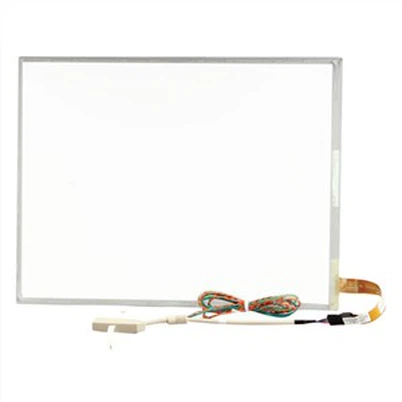
Resistive touch screen technology
Leave a message
Resistive Technology
Resistive touch screen technology provides impressive durability and resolution characteristics and can be used in a variety of applications. Since the touch screen senses input when touched by almost any object (finger, stylus/pen, palm), resistive touch screens are a type of ‘passive’ technology.
The analog resistive touch screen is a sensor which consists of two opposing layers, for example, a flexible top layer and a rigid bottom layer, each coated with a transparent resistive material - indium tin oxide (ITO). The ITO has typical sheet resistivity ranging between 100 and 500 ohms per square, with the layers separated by a pattern of minute, transparent insulating dots.
Silver ink bus bars (~50mW/sq) provide electrical connection to the ITO’s surface at the outside edges, spanning the desired axis of the given layer. Silver ink traces (~50mW/sq) join the bus bars to an electromechanical connector used for sensor interfacing. The cover sheet has a hard, durable coating on the outer side, and a conductive coating on the inner side. When touched, the conductive coating makes electrical contact with the glass coating, and a touch is registered by the analog controller.
With regard to applications, analog resistive technology can be ideally used for PDAs, web phones, and other handheld consumer applications.
Advantages:
• Works well with almost any stylus-like object, which can be sometimes even more desirable than a capacitive touch screen, which has to be operated with a capacitive pointer, such as a bare finger.
• Costs are relatively low in comparison to active touch screen technologies.
• Can be made to support multi-touch input.
• Offers cost-effective, consistent and durable performance in environments where equipment is susceptible to contaminants and liquids, like restaurants, factories, and hospitals.
Disadvantages:
• Passive touch screen design implies that when handwritten notes are taken with a stylus, the user cannot press the screen with his hand while writing. A few modern tablets
recognize both fingers and a stylus, and avoid this problem by deactivating recognition for non-stylus input when the stylus makes contact with the screen.
• R esistive technology provides only 75% optical transparency , with a sharp object capable of damaging the resistive layers.
Resistive Technology : Analog 4-wire Resistive, Analog 5-Wire Resistive, Analog 7-wire Resistive, Analog 8-wire Resistive, Features of resistive technology
Capacitive Technology: Surface Capacitive touch technology, Projected Capacitive touch technology