


LCD, OLED and Mini LED backlight panel comparison
Leave a message
Key Points
Apple will diversify its OLED display panel technology based on application as each product has different requirements in terms of size, form factor, cost composition, and input method
Apple will introduce a new iPad Pro with an OLED display panel in 2024, and the company also plans to introduce a MacBook Pro and other products with OLED display panels in the coming years.
Apple is currently experimenting with tandem RGB and hybrid OLED panels for its iPad Pro and MacBook Pro product lines to ensure better performance and consistent yields. Because each product has different requirements in terms of size, form factor, cost composition, and input method, Apple will diversify its OLED display panel technology adoption based on the application.
Apple will begin introducing products with OLED display panels in 2024
Apple is known to be launching a new iPad Pro with OLED display panels in 2024. LGD and SDC are currently preparing to mass produce tandem RGB multi- and hybrid OLED panels at their half-Gen 6-panel plants. BOE, Lakin Display, and Samsung Display are all currently preparing to invest in half-Gen 8.7-panel fabs to produce tandem RGB and hybrid OLED panels.
Apple launched its products with LCD panels more than a decade ago. A few years ago, the company began using mini LED-backlit LCD panels in the iPad Pro and MacBook Pro, which became the top-selling products in the Mini LED category. However, because of the high manufacturing costs of MiniLED display panels, demand for the panels from other IT device makers has hovered at a low level.
Figure 1: LCD, OLED, and Mini LED backlight panel cost comparison

Source:0mdia
In the short term, Apple's choice to use OLED display panels in its products makes sense, because since 2014, Apple has used OLED panels on the Apple Watch and iPhone but from a technical point of view, how to use OLED display panels for products with larger screens than the Apple Watch and iPhone will be a big problem. IT devices are often viewed at longer distances and used for longer periods of time than smartwatches or smartphones, such as watching movies, playing games, and working on documents. In addition, for manufacturing larger display panels for IT devices (compared to smartwatches or smartphones), ensuring stable yields and an appropriate cost structure are factors that cannot be ignored Tandem RGB and hybrid OLED panels ensure better performance and stable yields.
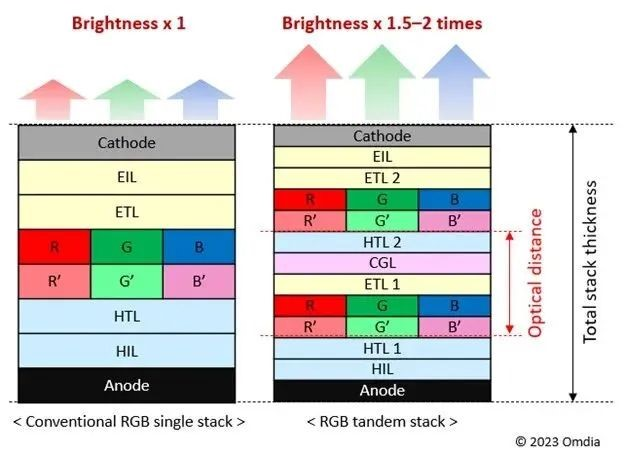
Tandem RGB and hybrid OLED panels ensure better performance and stable yields Tandem RGB and hybrid OLED panels are up to 2x brighter and up to 4x longer than single-layer RGB OLED panels, where the tandem structure of RGB is formed by stacking light-emitting materials. However, since additional layers of light-emitting materials are required, the material cost of such panels is correspondingly higher. In addition, the use of corresponding manufacturing systems (e.g. vapor deposition systems and vapor deposition masks) also needs to be expanded; compared to single-layer RGB OLED panels, tandem RGB OLED panels require twice as much vapor deposition equipment. Therefore, the thickness and properties of each layer in a tandem RGB OLED panel need to be optimized to ensure higher productivity.
Figure 2: Single-layer RGB vs. tandem RGB OLED panels
Source:0mdia
Hybrid OLED panels are made of glass substrates through a thin-film encapsulation (TFE) process and are thinner and lighter compared to hard-screen OLED panels and lower cost compared to flexible OLED panels. Therefore, it is preferable to produce TFTs on the surface of glass substrates (product substrates over 10 inches) for a simple production process and high yield.
TFE is very helpful when integrating other technologies such as touch sensors, COE, under-screen cameras, MLP, etc. on TFE, which can bring added value while maintaining quality. Therefore, since the Gen 6 flexible OLED production line can directly complete the TFE production process, it will also be more advantageous to produce hybrid OLED panels using Gen 6 flexible OLED capacity.
Figure 3: Hybrid OLED panels are thinner and lighter compared to hard OLED panels

Source:0mdia
Apple may use different OLED technologies based on application differentiation
Technology specifications vary by application; different IT devices have different usage environments, including size, viewing distance, brightness, lifespan, and operating methods
Figure 4: Apple's OLED panel roadmap for IT devices (0mdia projected)

First, when the size of 20 inches and above, the glass package can be used to replace the TFE; the larger the size, the lower the TFE yield However, if the yield of a larger TFE can remain stable, it is not necessary to use the glass package to replace the TFE.
Second, the glass substrate can be replaced with a flexible substrate for folding applications. apple is expected to launch a foldable iPad in 2026, but unless the display panel must be flexible (such as foldable or rollable), it does not have to be replaced with a flexible substrate. Third, oxide TFT panels will be used on the MacBook and iMac, while LTPO TFT panels will be used only on the iPad. oxide TFT panels are more suitable for notebook and display applications than LTPO TFT panels due to their cost competitiveness. For the same reason, OLED display panel suppliers are also trying to invest in the Gen 8.7 production line to produce OLED display panels for MacBook, which is expected to be in mass production by 2026. Fourth, the precision metal mask (FMM) process can be replaced with QDOLED, WOLED, or other production processes that do not require the use of FMM. The reason this process is difficult to apply to displays is due to limitations in FMM width (due to the Invar alloy sheet). As a result, some OLED display panel suppliers have recently become interested in the maskless version of the evaporation process from Applied MaterialsInc.


