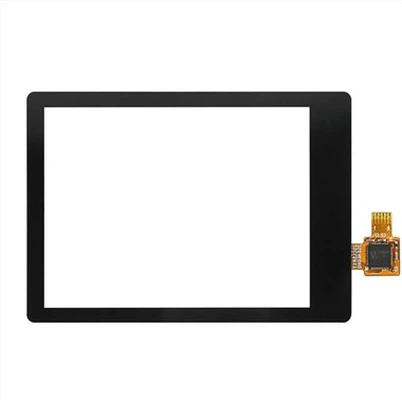
Component Classification Of Capacitive Touch Screen
Leave a message
Surface capacitive touch screen
The surface type capacitive touch screen is commonly used. Its working principle is simple, the price is low, and the design circuit is simple, but it is difficult to realize multi-touch.
Projected capacitive touch screen
The projected capacitive touch screen has a multi-finger touch function. Both capacitive touch screens have the advantages of high light transmittance, fast response speed, and long life. The disadvantages are: with the change of temperature and humidity, the capacitance value will change, resulting in poor working stability and often drifting. You need to check the screen frequently, and do not wear ordinary gloves for touch positioning.
Projected capacitive screens can be divided into two types: self-capacitance screen and mutual-capacitance screen. The more common mutual-capacitance screen is an example. The interior is composed of driving electrodes and receiving electrodes. The driving electrodes emit low-voltage and high-frequency signals and project them to the receiving electrodes to form a stable Electric current, when the human body touches the capacitive screen, because the human body is grounded, the finger and the capacitive screen form an equivalent capacitance, and high-frequency signals can flow into the ground through this equivalent capacitance. In this way, the amount of charge received at the receiving end is reduced. When the finger is closer to the transmitting terminal, the electric charge decreases more obviously. Finally, the touched point is determined according to the current intensity received by the receiving terminal.
The horizontal and vertical electrode arrays are made of ITO on the glass surface. These horizontal and vertical electrodes respectively form a capacitor with the ground. This capacitor is commonly referred to as self-capacitance, that is, the capacitance of the electrode to the ground. When the finger touches the capacitive screen, the capacitance of the finger will be superimposed on the capacitance of the screen body, which increases the capacitance of the screen body.
In the touch detection, the self-capacitance screen detects the horizontal and vertical electrode arrays in turn, and determines the horizontal and vertical coordinates according to the changes in capacitance before and after the touch, and then combines them into planar touch coordinates. The self-capacitance scanning method is equivalent to projecting the touch points on the touch screen to the X-axis and Y-axis directions respectively, and then calculate the coordinates in the X-axis and Y-axis directions respectively, and finally combine them into the coordinates of the touch point.
If it is a single-point touch, the projections in the X-axis and Y-axis directions are unique, and the combined coordinates are also unique. If there are two touches on the touch screen and the two points are not in the same X direction or the same Y direction, then If there are two projections in the X and Y directions, 4 coordinates are combined. Obviously, only two coordinates are real, and the other two are commonly known as "ghost points". Therefore, the self-capacitive screen cannot achieve true multi-touch.
The mutual capacitance screen is also made of ITO on the glass surface to make horizontal and vertical electrodes. The difference between it and the self-capacitance screen is that a capacitance will be formed where two sets of electrodes intersect, that is, these two sets of electrodes constitute the two poles of the capacitance respectively. When the finger touches the capacitive screen, it affects the coupling between the two electrodes near the touch point, thereby changing the capacitance between the two electrodes. When detecting the mutual capacitance, the horizontal electrodes send out excitation signals in turn, and all the vertical electrodes receive signals at the same time. In this way, the capacitance value of the intersection of all the horizontal and vertical electrodes can be obtained, that is, the capacitance of the two-dimensional plane of the entire touch screen. According to the two-dimensional capacitance change data of the touch screen, the coordinates of each touch point can be calculated. Therefore, even if there are multiple touch points on the screen, the true coordinates of each touch point can be calculated.
The advantage of the mutual capacitance screen is that there is less wiring, and it can recognize and distinguish the difference between multiple contacts at the same time. The self-capacitance screen can also sense multiple contacts, but because the signal itself is blurred, it cannot be distinguished. In addition, the sensing scheme of the mutual capacitance screen has the advantages of fast speed and low power consumption, because it can measure all nodes on a driving line at the same time, so it can reduce the number of acquisition cycles by 50%. This two-electrode structure has the function of self-shielding external noise and can improve the signal stability at a certain power level.
In any case, the touch position is determined by measuring the distribution of signal changes between the X and Y electrodes, and then mathematical algorithms are used to process these changed signal levels to determine the XY coordinates of the touch point.