What is a bar type display?
Leave a message
Stretched monitors, as the fundamental form of the stretched display family, are characterized by breaking away from the traditional 16:9 aspect ratio, utilizing an ultra-wide screen design to achieve high-density information display. Originally stemming from the professional needs of industrial control scenarios, their elongated display dimensions allow for the simultaneous display of key information such as operating parameters and process flow nodes for multiple production lines, avoiding the screen fragmentation and installation complexities associated with multi-screen setups. In terms of technological maturity, early products primarily used LCD technology, dominating the market with a high yield rate of 96.8%. As the industry developed, it gradually upgraded to higher refresh rates and resolutions, with 4K and higher resolution products now accounting for 32.4% of the market. This better suits high-end industrial scenarios such as precision manufacturing and energy monitoring, while also expanding applications in outdoor advertising and rail transit, becoming a display solution that balances professionalism and versatility.
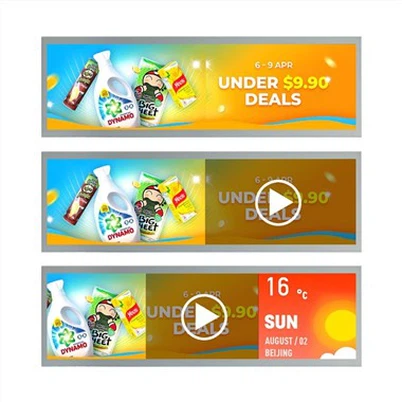
With the advancement of digital transformation, stretched display technology continues to iterate, giving rise to more diverse product types and wider applications. The emergence of stretched displays has broken the limitations of a single hardware form, creating a landscape where multiple technology routes such as LED, OLED, and Mini LED coexist. OLED technology, with its ultra-high contrast ratio of 1,000,000:1 and extremely fast response time of 0.01ms, has rapidly penetrated high-end automotive and flexible display scenarios, reaching a market penetration rate of 23.4% in 2024. Mini LED, as an emerging technology, accounts for 71.3% of global patent applications in China, becoming a key direction for domestic enterprises to build core competitiveness. Application scenarios have also expanded from industrial control to commercial retail, transportation, and smart healthcare. For example, electronic price tags on retail shelves can simultaneously display product prices, promotional information, and inventory status via ultra-wide displays, while information guidance screens in transportation hubs can clearly present real-time dynamics of multiple routes, significantly improving information transmission efficiency.
Driven by the needs of specific scenarios, stretched display products are further developing towards precision, forming specialized forms tailored to confined spaces and specific information display requirements. These products focus on bar-shaped installation scenarios, and their slim design allows them to be flexibly embedded in limited spaces such as shelves, columns, and vehicle interiors. They are perfectly suited for niche applications such as new retail price tags, in-car control panels, and subway platform signage. Their ultra-narrow bezel design also enables seamless visual effects for multi-screen splicing, meeting the information display needs of large venues. Currently, the market share of ultra-wide aspect ratio products (21:9 and above) has increased from 18.3% in 2023 to 22.1%, becoming one of the fastest-growing subcategories. In the future, with the implementation of cutting-edge technologies such as Mini LED and Micro LED, and the deepening of smart city construction, stretched bar monitors, which combine portability, professionalism, and customization advantages, will achieve breakthroughs in more professional scenarios, driving the stretched display industry towards differentiation and high-end development.