IPS & TFT Display Features
Leave a message
TFT (Thin-Film-Transistor) Liquid Crystal Display is a thin display type, where a transistor embedded into each crystal gate; these transistors are then printed on thin-transparent film. The technology was designed to improve image qualities, such as contrast and addressability.
Also designed in the late 1980's, TFT display technologies is just another variation of LCD displays that offer greater color, contrast, and response times as opposed to available passive matrix LCD's. One of the primary differences between IPS and TFT display technologies is the cost. IPS is more expensive than TN technology. However, there are some key differences between the two that should be noted.
IPS & TFT Display Features
Before we go into the differences, let's talk about features of each technology. Note that we're not talking TVs, computer, or tablets, but screens on a much smaller scale, (think 7" or smaller) which uses different rules to fit that scale. First, it's interesting to discover that the TFT display technologies is the most common type of color display technology; more monochrome displays still out-sell color, due to lower cost and lower power consumption, however, the narrow poor visibility of TFTs in direct sunlight is their downside; but I'm getting ahead of myself here.
IPS technology has come a long way in regards to cell phones and other LCD screens that are even much smaller. (Picture digital clocks on a radio, microwave, and hand-held games) Some of the features of an IPS screen include:
Wider viewing angles – crystals are aligned horizontally rather than vertically, so it allows for better angled viewing, perfect for smaller screens, where you need to rotate the screen for better viewing
Lower power consumption, resulting in longer battery life – again for smaller screens, this works great, because even though this technology requires more power, a smaller screen has less power drain.
Brilliant color image – this is a huge advance in technology, from a Twisted Nematic (TN) display that only produced 6-bit color, to an 8-bit color display with the IPS technology
Variations to help with user's viewing requirements or desires – there are several different forms of IPS technology: Super-IPS, (S-IPS) Advanced Super IPS, Advanced S-IPS, where the liquid crystal molecules stay parallel to the front and back panels, instead of perpendicular when a voltage is applied
Consistent, accurate color, under different viewing angles
Clear images and stable response time, which allows for faster response time – good for videos.
TFT display technologies have developed over the years and have become quite popular in tech circles. The features offered with this advancing technology are:
Superior color display – for technology that requires it or for consumers that desire color screens
Not only is the color superb, but the clarity outstanding
Features a longer half-life, (half-life is the amount of time in hours before the display is 50% as bright as when it was first turned on), than OLEDs and comes in varying sizes, from under an inch up to over 15 inches
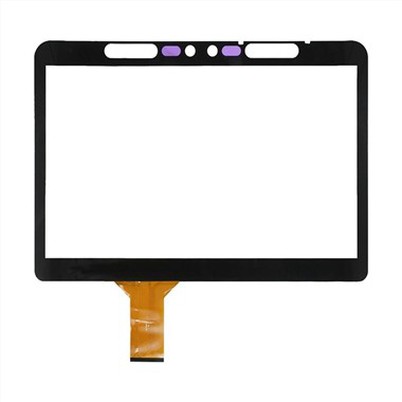
Capacitive Touchscreen or touch panel, which is in the majority of Smartphones and allows for additional functionality, specifically for zooming and scrolling
Resistive touch panel which is lower in cost and are usually standard on most TFT devices
Aspect ratio control, which refers to a screen's ability to maintain an aspect ratio of a source image at the hardware level, and 1:1 pixel mapping, used to literally "map" the exact number of pixels specifically in the source resolution to pixels on the screen
No "ghosting" (ghosting is when an image will stay on for a short time when instead it should be off)
Variety of displays, which can be interfaced through a variety of bus types, including 18 and 24 bit for red/green/blue, LVDS, and 8 bit and 16 bit for a CPU – many controllers allow for two or more different types of interfaces on the same TFT screen