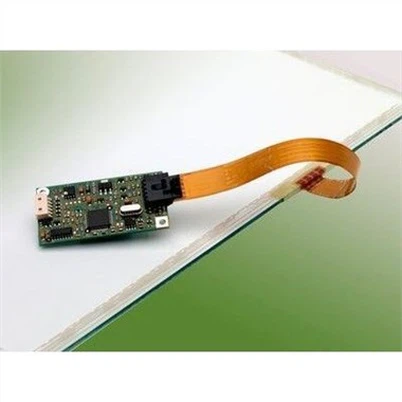
A Brief Discussion on Capacitive Screens, Surface Capacitive Touch Screens and Projected Capacitive Touch Screens
Leave a message
What is a Capacitive Screen?
Touch Panel (TP), also known as "touch screen" or "touch panel", relies on touch sensor technology to input information. According to different working principles, touch screens can be divided into resistive, capacitive, optical, ultrasonic and electromagnetic induction categories.
Capacitive touch screens have become the current mainstream technology product due to their high sensitivity, good light transmittance, strong stability and long service life. Its working principle is to sense the electrical current of the human body. Its main feature is that it can achieve multi-touch, reach 99% accuracy, and have a sensitive response speed. It supports multi-touch and is widely used in fields such as smart consumer electronics, industrial medical equipment, smart homes, office equipment, and automotive electronics. Capacitive screens are mainly divided into two categories: surface capacitive and projected capacitive.
Surface Capacitive Touch Screen
The structure of the surface capacitive touch screen is to coat a transparent conductive coating on the glass base, and then add a protective coating on the conductive coating. Its working principle is: the electrodes are placed at the four corners of the glass, and the same phase voltage is applied to the four corners, forming a uniform electric field on the glass surface. When a finger touches the glass surface, current will flow through the finger from the four corners of the glass, and the proportion of the current flowing from the four corners will be measured to determine the specific location of the touch point. The measured current value is inversely proportional to the distance from the touch point to the four corners. Learn More

Projected Capacitive Touch Screen
Compared with surface capacitive touch screens, projected capacitive touch screens are usually used in smaller sizes. The internal structure includes a circuit board integrated with an IC chip for processing data, with many transparent electrode layers in a pattern, and the surface is covered with a layer of insulation. glass or plastic cover. When a finger approaches the touch screen surface, the electrostatic capacitance changes simultaneously among multiple electrodes. By measuring the ratio between these currents, the contact position can be accurately determined. At the same time, projected capacitive technology has two sensing methods, namely grid type and line type. Learn More

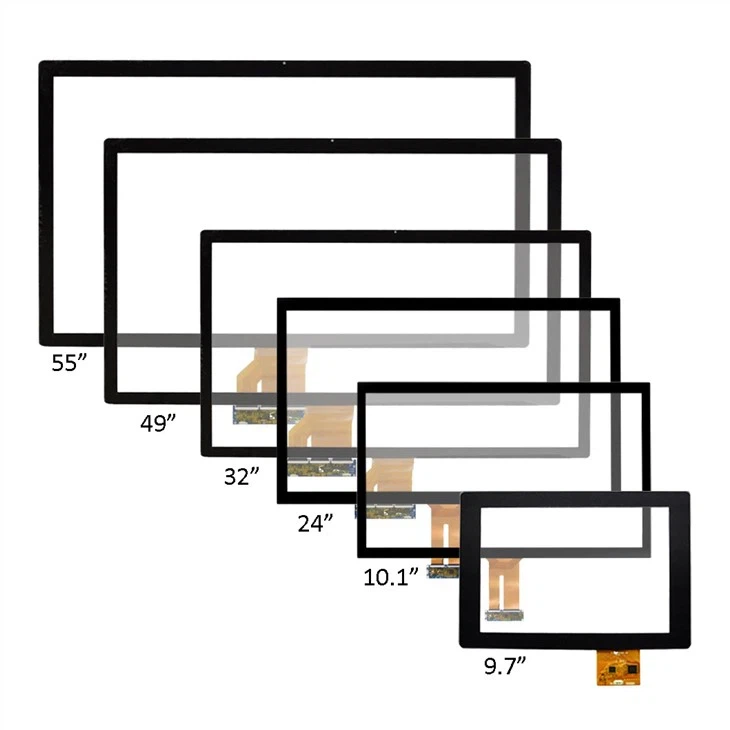
Surface Capacitive Touch Screen VS Projected Capacitive Touch Screen
Surface Capacitive Touch Screen | Projected Capacitive Touch Screen |
Application scenarios: Usually used for larger sizes, such as tablets, TVs, etc. Advantages: lower cost. Disadvantages: low penetration rate and poor color performance. | Application scenario: Usually used in smaller sizes, such as smartphones, handheld devices, etc. Advantages: high penetration rate; realistic colors; long life; supports multi-touch. Disadvantages: higher cost; complex process. |